|
Big Tire, Little Lift
The best set up for your Jeep is to use the least amount of
lift possible to fit your target tire size. The less lift
you have, the lower your center of gravity and springs with
less arc flex better than springs with more arc. Besides
suspension lifts, body lifts and fender trimming can be used
to fit big tires. My goal was to fit 33s so that I could do
all the hard trails with the least amount of lift possible.
Suspension Lift
Everything being equal, a flat spring pack will articulate better
than an arced spring pack because flat spring leaves are able to
move equally well up and down. As the arc of a spring increases,
it's ability to compress decreases. Spring lifts also increase
your center of gravity since they raise the height of the entire
vehicle.
Another disadvantage of tall springs is steep drive shaft angles.
Steeper drive shaft angles can cause vibration problems and decrease
u-joint life. Often, shims are used under the spring perches
and transfer case lowering kits are added to resolve drive line
vibration problems. The shims have a tendency to break and fall
out. Large shims will starve the pinion bearing of gear lube
and decrease its life. Sometimes the spring king pin will have to
be replaced with a longer one when large shims are used. If the
large king pin is not used, the axle housing may shift if the king
pin does not have a firm hold in the spring perch.
The transfer case lowering kits reduce clearance.
Body Lift
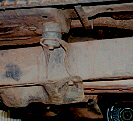 An advantage of the body lift is it does not raise the height
of the engine, transmission, transfer case, or frame. Normally
these are the heaviest parts of your Jeep. A body lift is better
for your center of gravity than a suspension lift, but body lifts
tend to allow more flex between the tub and frame. The more you
lift your body, the more flex you get. A lot of flex will eventually
rip body mounts off of the tub.
An advantage of the body lift is it does not raise the height
of the engine, transmission, transfer case, or frame. Normally
these are the heaviest parts of your Jeep. A body lift is better
for your center of gravity than a suspension lift, but body lifts
tend to allow more flex between the tub and frame. The more you
lift your body, the more flex you get. A lot of flex will eventually
rip body mounts off of the tub.
Fender Trimming
Minor fender trimming is easy to do and it can be done so it is
not at all noticeable. I've heard many stories of people who were
reluctant to do fender trimming and ended up with a dented quarter
panel when the tire made contact. Some minor fender trimming would
have saved them expensive body work.
The Solution
From talking with people over the net, I determined that it would
take a combination of all three techniques to fit 33s on my CJ with
the least amount of lift. I started with a 2 1/2" suspension lift,
added a 1" body lift, and did some minor fender trimming.
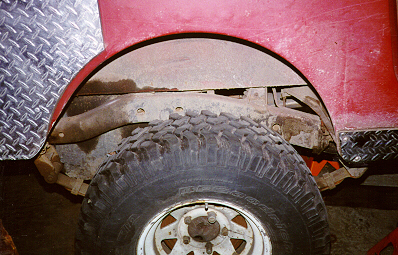
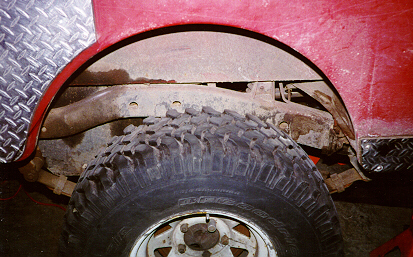
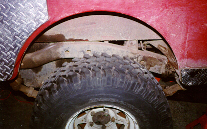 This picture was taken before I did
minor fender trimming, and the picture above is after the fender
trimming. If you look closely, you can see a line drawn in magic
marker showing where the fender was cut. Once I painted the diamond
plate to match the rest of the Jeep, the cut wasn't noticeable at
all. I used a circular saw with a metal cutting blade to make the
cut and touched it up with some paint.
This picture was taken before I did
minor fender trimming, and the picture above is after the fender
trimming. If you look closely, you can see a line drawn in magic
marker showing where the fender was cut. Once I painted the diamond
plate to match the rest of the Jeep, the cut wasn't noticeable at
all. I used a circular saw with a metal cutting blade to make the
cut and touched it up with some paint.
Jeep CJs and Wrangler YJ tubs will need this piece removed to fit
33s, or a 4" suspension lift. A Wrangler might need more body lift
to fit 33s with out hitting, but I'd be a bit reluctant to go over
1".
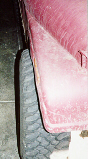 When I switched rear axles to a Commando Dana 44 the tires rub a
little on the inside of the fender since the Commando axle is about
1/2" narrower than my narrow track AMC 20. My front end is a Scout
Dana 44 cut to CJ wide track specifications. My narrow track Dana
30 would allow the front tires to tuck right in, but the wider axle
causes the front tires to rub the outside edge of the front fender.
I just bent the fender out a bit to stop the rubbing.
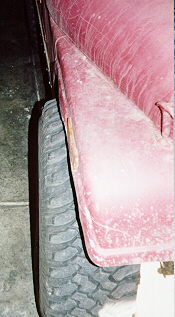
If you look closely at the picture to the right, you can see where I
bent the fender out by hand, just behind the marker light. I used
a rock to hammer in the inside edge of the fender.
Eventually,
I will chop the fenders for the
flat fender look.
When I switched rear axles to a Commando Dana 44 the tires rub a
little on the inside of the fender since the Commando axle is about
1/2" narrower than my narrow track AMC 20. My front end is a Scout
Dana 44 cut to CJ wide track specifications. My narrow track Dana
30 would allow the front tires to tuck right in, but the wider axle
causes the front tires to rub the outside edge of the front fender.
I just bent the fender out a bit to stop the rubbing.
If you look closely at the picture to the right, you can see where I
bent the fender out by hand, just behind the marker light. I used
a rock to hammer in the inside edge of the fender.
Eventually,
I will chop the fenders for the
flat fender look.
Last modified Wednesday, 01-Dec-2010 09:20:21 MST
[
Jeep Tech Main Page |
Terry's Jeep Page
]
Copyright © 2001, 2000, 1999, 1998
JEEPTECH.COM
All Rights Reserved, All content with exception of private works and
corporate trademarked logos are property of Jeeptech.com
|